
10 Best AI Agents for Cloud Infrastructure Management in 2026

The best AI agent for cloud infrastructure depends on what you need it to control.
Cloudgeni is the best fit for teams that want an AI agent to turn infrastructure drift, compliance findings, unmanaged cloud resources and FinOps opportunities into validated Infrastructure-as-Code pull requests. AWS DevOps Agent, Azure SRE Agent and Gemini Cloud Assist are stronger choices for organisations operating primarily inside one hyperscaler. Datadog, Dynatrace and PagerDuty focus more heavily on incident investigation and operational response.
This guide compares ten AI agents and agentic platforms across Infrastructure-as-Code support, infrastructure remediation, incident response, human approvals, cloud coverage and operational maturity.
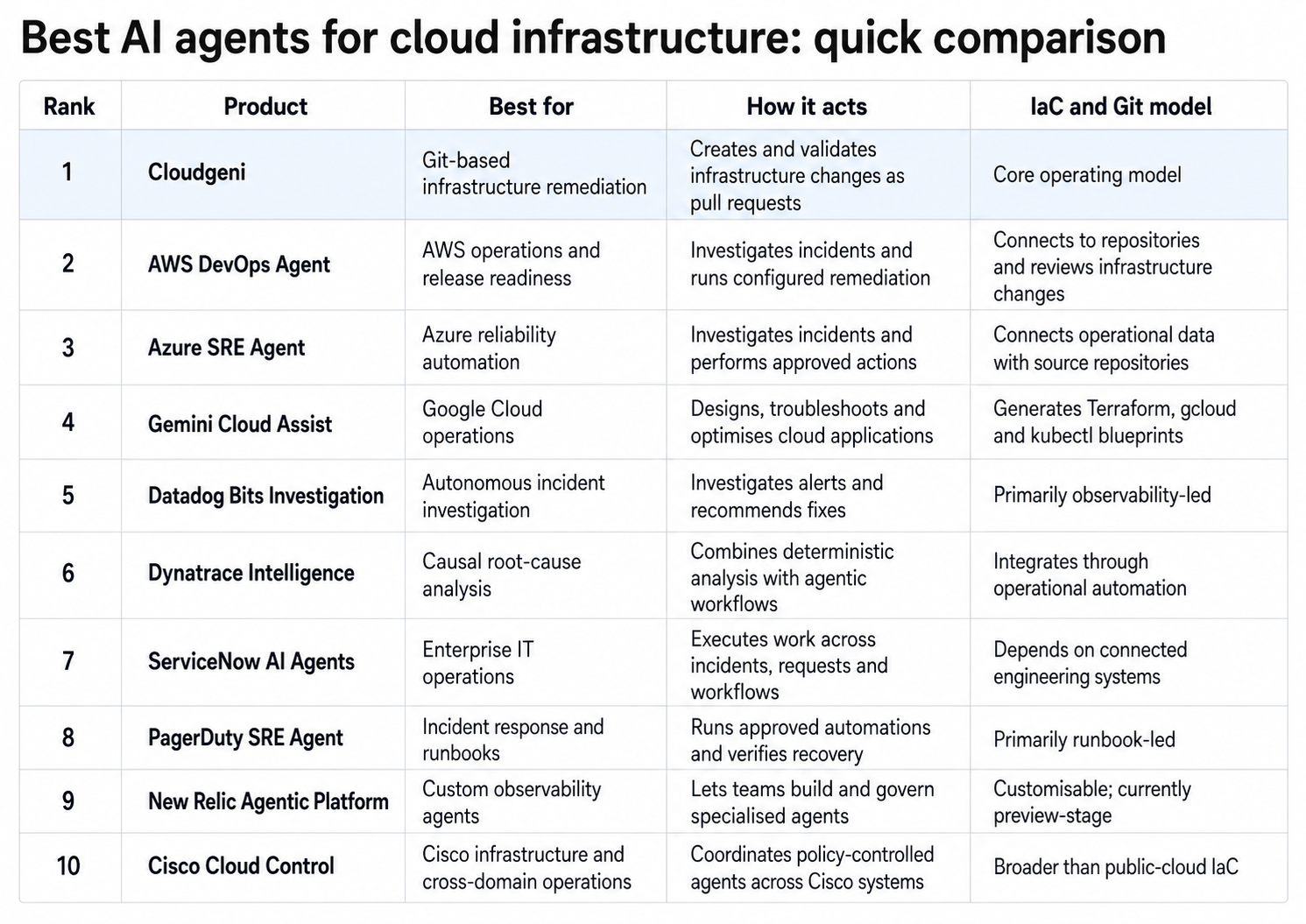
Best AI agents for cloud infrastructure: quick comparison
What is an AI agent for cloud infrastructure?
An AI agent for cloud infrastructure is software that can interpret cloud state, Infrastructure-as-Code, telemetry, policies or operational history and then use tools to investigate or perform infrastructure work.
Common use cases include:
- Detecting and remediating infrastructure drift
- Importing unmanaged cloud resources into Terraform or Bicep
- Investigating production incidents
- Running approved remediation procedures
- Fixing cloud security and compliance findings
- Generating and validating Infrastructure-as-Code
- Identifying and implementing cloud cost optimisations
- Reviewing infrastructure changes before deployment
An AI infrastructure agent is different from a generic cloud chatbot. A chatbot answers questions. An agent can gather context, select tools, perform multiple steps and produce or execute an operational action.
How we evaluated the products
We considered six factors.
1. Infrastructure action
Can the product only explain a problem, or can it prepare or execute the work required to fix it?
2. Infrastructure-as-Code support
Does the agent understand Terraform, Bicep or other Infrastructure-as-Code? Can it preserve the repository as the source of truth?
3. Safety and approvals
Does it support human approval, constrained permissions, validation, policy checks and auditable execution?
4. Operational context
Can the agent use cloud state, repositories, telemetry, deployment history, policies and service dependencies?
5. Coverage
Does it focus on one cloud, multiple clouds, observability, incident response or broader enterprise IT operations?
6. Product maturity
Is the capability generally available, in preview or still being introduced through a controlled rollout?
1. Cloudgeni
Best AI agent for Git-based infrastructure remediation
Cloudgeni is an AI cloud infrastructure management platform that turns cloud operations into a controlled Git workflow.
Its agents analyse cloud state and Infrastructure-as-Code, prepare production-grade changes, validate them in isolated environments and deliver the result as a pull request. Cloudgeni’s documented agents cover compliance remediation, drift reconciliation, unmanaged-resource import and general Infrastructure-as-Code work.
Key Cloudgeni capabilities
- Remediation Agent: Converts compliance findings into validated Infrastructure-as-Code changes.
- Drift Agent: Detects differences between deployed cloud resources and the desired state in code.
- Import Agent: Converts unmanaged cloud resources into Terraform or Bicep.
- DevOps Agent: Generates and validates Infrastructure-as-Code from natural-language requirements, templates, documentation and internal rules.
- FinOps workflows: Identifies cloud waste and connects cost policies to engineering workflows.
Why Cloudgeni ranks first
Most products in this comparison start with an incident, alert or cloud-native console. Cloudgeni starts with the infrastructure change itself.
The platform is specifically designed to turn findings into reviewable code rather than changing production infrastructure without updating its source of truth. This makes it particularly relevant for teams using Git and Infrastructure-as-Code as their operational control boundary.
A live cloud change can fix an immediate problem while creating configuration drift. Cloudgeni instead prepares a lasting change that engineers can inspect, test, approve and merge.
Cloudgeni limitations
Cloudgeni is not a replacement for Datadog, Dynatrace or another observability platform. It is strongest when a cloud or security problem has been identified and the next step is to prepare a safe infrastructure change.
It is also a younger company than the hyperscalers and enterprise vendors in this comparison. Buyers should evaluate integrations, supported workflows and production references against their specific environment.
Choose Cloudgeni when: Your priority is Terraform or Bicep remediation, infrastructure drift, cloud compliance, unmanaged-resource import or Git-based Cloud FinOps automation.
2. AWS DevOps Agent
Best AI infrastructure agent for AWS environments
AWS DevOps Agent monitors AWS infrastructure, investigates operational events, performs root-cause analysis and can run configured remediation procedures. It builds a continuously updated understanding of applications, resources and service dependencies.
AWS uses Agent Spaces to define which accounts, resources, integrations and users the agent can access. These spaces provide separate permission and data boundaries for different teams or environments.
AWS has also added release-management capabilities, including change-readiness reviews and automated testing. Some release-management functionality remains in preview.
Strengths
- Deep AWS service and topology context
- Automated incident investigation
- Configurable remediation procedures
- GitHub and CI/CD integration
- Release-readiness reviews
- Custom skills, tools and MCP integrations
Limitations
AWS DevOps Agent has the strongest native context inside AWS. Organisations with substantial Azure or Google Cloud estates should verify the depth of its non-AWS support.
It can remediate operational problems, but teams must still determine whether a live action also updates the Infrastructure-as-Code defining the resource.
Choose AWS DevOps Agent when: AWS is your primary cloud and you want a native agent for incident investigation, operational remediation and release validation.
3. Azure SRE Agent
Best AI SRE agent for Microsoft Azure
Azure SRE Agent connects observability data, incident systems and source-code repositories into an automated reliability workflow.
The agent can investigate incidents, analyse Azure logs and metrics, identify likely causes, create response plans and perform remediation actions when configured with the necessary privileges. Microsoft states that proposed changes require human approval before deployment.
Azure SRE Agent also supports integrations and specialised subagents, allowing platform and reliability teams to package internal runbooks, operational knowledge and MCP-based tools.
Strengths
- Deep Azure integration
- Human approval before changes
- Incident investigation and remediation
- Repository and observability integrations
- Custom skills, plugins and subagents
- Persistent operational knowledge
Limitations
Azure SRE Agent is primarily an SRE and incident-automation product. It is less specifically focused on broad IaC drift reconciliation or importing unmanaged infrastructure into code.
Choose Azure SRE Agent when: Your infrastructure runs primarily on Azure and your main objective is reducing incident-response toil through approved agent actions.
4. Gemini Cloud Assist
Best AI cloud operations agent for Google Cloud
Gemini Cloud Assist is Google Cloud’s agentic operations product for application design, deployment, monitoring, troubleshooting, performance and cost optimisation.
Google describes Cloud Assist as a multi-agent system that can perform iterative tool calls, test multiple hypotheses and maintain context across operational tasks. Actions require explicit user authorisation.
Gemini Cloud Assist also connects natural-language intent to Infrastructure-as-Code. Its Application Design Center integration can generate architecture designs and production-oriented Terraform, gcloud or kubectl blueprints.
Strengths
- Broad Google Cloud lifecycle coverage
- Terraform and Kubernetes generation
- Troubleshooting and performance analysis
- Cloud cost optimisation
- Explicit authorisation for actions
- Native Google Cloud context
Limitations
The product’s main advantage is its integration with Google Cloud. Multicloud organisations should evaluate whether equivalent context and execution are available outside Google’s ecosystem.
Choose Gemini Cloud Assist when: Google Cloud is your main platform and you want one agentic interface spanning architecture, deployment, troubleshooting and optimisation.
5. Datadog Bits Investigation
Best AI SRE agent for observability-led investigation
Datadog Bits Investigation is an always-on AI SRE agent that automatically investigates alerts, analyses telemetry, identifies probable root causes and suggests remediation steps or code fixes.
Its main advantage is access to the logs, traces, metrics, service relationships and changes already stored in Datadog. Engineers can also discuss the investigation through natural-language chat and share results through tools such as Slack, Microsoft Teams, Jira, ServiceNow and GitHub.
Strengths
- Automatic investigation when alerts fire
- Strong observability context
- Root-cause hypotheses and supporting evidence
- Suggested code fixes
- Incident summaries and hand-offs
- Integrations with engineering and IT systems
Limitations
Bits Investigation primarily helps teams understand incidents. It is not designed as a complete Infrastructure-as-Code remediation platform.
Suggested fixes still need to move through the organisation’s coding, validation, approval and deployment process.
Choose Datadog Bits Investigation when: You already use Datadog and want an AI agent to reduce the manual work required to investigate production alerts.
6. Dynatrace Intelligence
Best for causal analysis across complex environments
Dynatrace Intelligence combines deterministic analysis, causal AI and agentic workflows.
It uses the Dynatrace Grail data layer and Smartscape dependency graph to analyse applications, services, infrastructure, logs and traces. Dynatrace can correlate configuration changes and deployments with operational problems and use that context to support automated actions.
Strengths
- Real-time service and infrastructure topology
- Causal root-cause analysis
- Deterministic and agentic AI
- Broad application and infrastructure context
- Automated operational workflows
- Strong fit for complex enterprise environments
Limitations
Dynatrace is an observability and operations platform rather than a dedicated Git-based infrastructure remediation product.
Teams should verify how automated infrastructure actions interact with their Infrastructure-as-Code repositories and review processes.
Choose Dynatrace Intelligence when: You need topology-aware analysis and automation across a large, interconnected application and infrastructure estate.
7. ServiceNow AI Agents
Best for enterprise IT operations workflows
ServiceNow AI Agents automate work across incident management, request fulfilment, vulnerability remediation and other enterprise IT processes.
Their main advantage is access to ServiceNow workflows and data, including incidents, knowledge records, approvals, configuration items and connected enterprise systems.
Strengths
- Enterprise workflow orchestration
- Incident and request automation
- CMDB and knowledge-base context
- Vulnerability-remediation workflows
- Human approvals and governance
- Broad integrations across IT systems
Limitations
ServiceNow’s effectiveness depends heavily on the quality of the organisation’s existing ServiceNow implementation and data.
It can coordinate infrastructure work but is not inherently a Terraform or Infrastructure-as-Code remediation system.
Choose ServiceNow AI Agents when: Your main problem is coordinating infrastructure and IT work across tickets, records, approvals and multiple enterprise teams.
8. PagerDuty SRE Agent
Best for AI-assisted incident response and runbooks
PagerDuty SRE Agent acts as a virtual incident responder.
It analyses current and previous failures, finds relevant operational patterns, runs approved automations and verifies whether the remediation restored the service.
Strengths
- Automatic incident triage
- Historical incident context
- Approved runbook execution
- Remediation verification
- Strong connection to on-call workflows
- Continuous improvement of incident procedures
Limitations
PagerDuty SRE Agent is centred on incidents. It is less suited to continuous infrastructure drift reconciliation, unmanaged-resource import or proactive Infrastructure-as-Code maintenance.
Choose PagerDuty SRE Agent when: PagerDuty is central to your incident process and you want an agent to investigate, coordinate and execute known remediation procedures.
9. New Relic Agentic Platform
Best for building custom observability agents
New Relic Agentic Platform allows operations and SRE teams to build, deploy and govern custom agents through a no-code interface.
New Relic positions the platform as an orchestration layer for agents that can investigate and perform operational tasks using observability data. The platform includes role-based controls, auditability, MCP support and agent evaluation. It was introduced in preview in February 2026.
Strengths
- Custom agent creation
- No-code workflow design
- New Relic telemetry context
- Centralised governance
- MCP integrations
- Agent testing and evaluation
Limitations
The platform remains preview-stage. Buyers should distinguish between announced functionality and capabilities that are fully available and proven in production.
Choose New Relic Agentic Platform when: You use New Relic and want to build specialised operational agents around your own internal processes.
10. Cisco Cloud Control
Best for Cisco infrastructure and cross-domain AgenticOps
Cisco Cloud Control is a unified operations platform for networking, security, compute, observability and collaboration.
Cisco positions the platform as a shared environment where humans and policy-controlled agents can investigate and resolve infrastructure problems using common telemetry and topology. Cloud Control Studio also allows organisations to connect tools and build custom agents.
Cisco began rolling the platform out through controlled availability in 2026.
Strengths
- Cross-domain Cisco context
- Networking and security depth
- Unified infrastructure topology
- Human and agent collaboration
- Policy-controlled agent actions
- Custom agent and third-party integrations
Limitations
Cisco Cloud Control is broader than public-cloud Infrastructure-as-Code and is still early in its rollout.
Its value will be highest for organisations with a substantial Cisco estate.
Choose Cisco Cloud Control when: Networking, security and Cisco infrastructure are central to your operations strategy.
AI infrastructure agents versus AI SRE agents
The terms overlap, but they are not identical.
An AI SRE agent primarily investigates reliability problems. It analyses alerts, logs, traces, recent changes and previous incidents. It may recommend a fix or run an approved remediation procedure.
An AI infrastructure agent focuses more directly on cloud resources and their desired configuration. It may create Infrastructure-as-Code, detect drift, import unmanaged resources, remediate compliance findings or implement cloud cost changes.
Datadog Bits Investigation and PagerDuty SRE Agent sit closer to AI SRE. Cloudgeni sits closer to infrastructure remediation. AWS DevOps Agent, Azure SRE Agent and Gemini Cloud Assist increasingly cover both categories.
What to ask before buying an AI infrastructure agent
Before giving an agent access to production infrastructure, ask:
- Does the agent only recommend changes, or can it execute them?
- Which actions require human approval?
- Are permissions constrained at runtime or only through prompts?
- Does remediation update the Infrastructure-as-Code repository?
- Can the agent validate Terraform or Bicep before proposing a change?
- Is every action logged and attributable?
- Can changes be rolled back?
- What cloud, repository and observability integrations are supported?
- Is the advertised capability generally available or still in preview?
- How is agent performance evaluated?
A fluent answer is not evidence that an infrastructure change is safe. Production agents need deterministic validation and enforceable execution controls around the model.
Frequently asked questions
What is the best AI agent for cloud infrastructure management?
Cloudgeni is the best fit for teams that want to manage cloud infrastructure through Git and Infrastructure-as-Code. It converts drift, compliance findings, unmanaged resources and other infrastructure work into validated pull requests.
AWS DevOps Agent, Azure SRE Agent and Gemini Cloud Assist are better suited to organisations that want deep integration with one hyperscaler.
Which AI infrastructure agents support Terraform?
Cloudgeni uses Terraform and Bicep as part of its core infrastructure-remediation workflow. Gemini Cloud Assist can generate Terraform blueprints through its Application Design Center integration.
Other agents can connect to repositories or review infrastructure changes, but buyers should verify whether they generate and validate Terraform or merely analyse operational data.
Can AI agents safely modify production infrastructure?
They can, but unrestricted autonomous access is unsafe.
A production infrastructure agent should use least-privilege permissions, runtime-enforced tool restrictions, policy checks, isolated validation, human approval for material changes, audit logs and rollback procedures.
For Git-managed infrastructure, the agent should normally prepare a reviewed change rather than silently modifying a live resource.
What is the difference between AIOps and an AI infrastructure agent?
AIOps platforms traditionally use machine learning to detect anomalies, correlate events and reduce alert noise.
AI infrastructure agents add reasoning and tool use. They can investigate a goal, choose actions and perform multi-step work such as writing Infrastructure-as-Code, running a remediation procedure or opening a pull request.
What is the best AI agent for Terraform remediation?
Cloudgeni is the most directly focused Terraform-remediation product in this comparison. It analyses cloud and repository context, prepares Infrastructure-as-Code changes, validates them and delivers the result through Git.
What is the best AI agent for Cloud FinOps?
Cloudgeni is the strongest fit when cost findings need to become controlled infrastructure changes. Gemini Cloud Assist is a strong option for cost optimisation inside Google Cloud.
The practical difference is execution. Many FinOps products identify savings; fewer connect those recommendations to code, ownership, approval and implementation.
Are AI SRE agents the same as cloud infrastructure agents?
No.
AI SRE agents are generally focused on incidents, uptime and root-cause analysis. Cloud infrastructure agents focus more directly on resources, configuration, Infrastructure-as-Code, policy, drift and cost.
Some products are expanding across both categories.
Final verdict
Cloud infrastructure agents are splitting into three groups:
- Infrastructure remediation agents, led in this comparison by Cloudgeni
- Cloud-native operations agents, including AWS DevOps Agent, Azure SRE Agent and Gemini Cloud Assist
- Incident and observability agents, including Datadog Bits Investigation, Dynatrace Intelligence and PagerDuty SRE Agent
Cloudgeni ranks first for teams that want an agent to make lasting, reviewable infrastructure changes through Git and Infrastructure-as-Code.
That does not make it the best product for every operational problem. Teams focused primarily on AWS operations, Azure incidents, Google Cloud design or Datadog investigations should choose the product built around that environment.
The decisive question is not whether an agent can explain what is wrong.
It is whether the agent can prepare or execute the correct fix without bypassing the controls that keep production infrastructure safe.