
What Is AI SRE?
AI SRE is moving beyond alert summaries and root-cause suggestions. Its real value starts when an agent can turn evidence into a safe, verifiable infrastructure change.

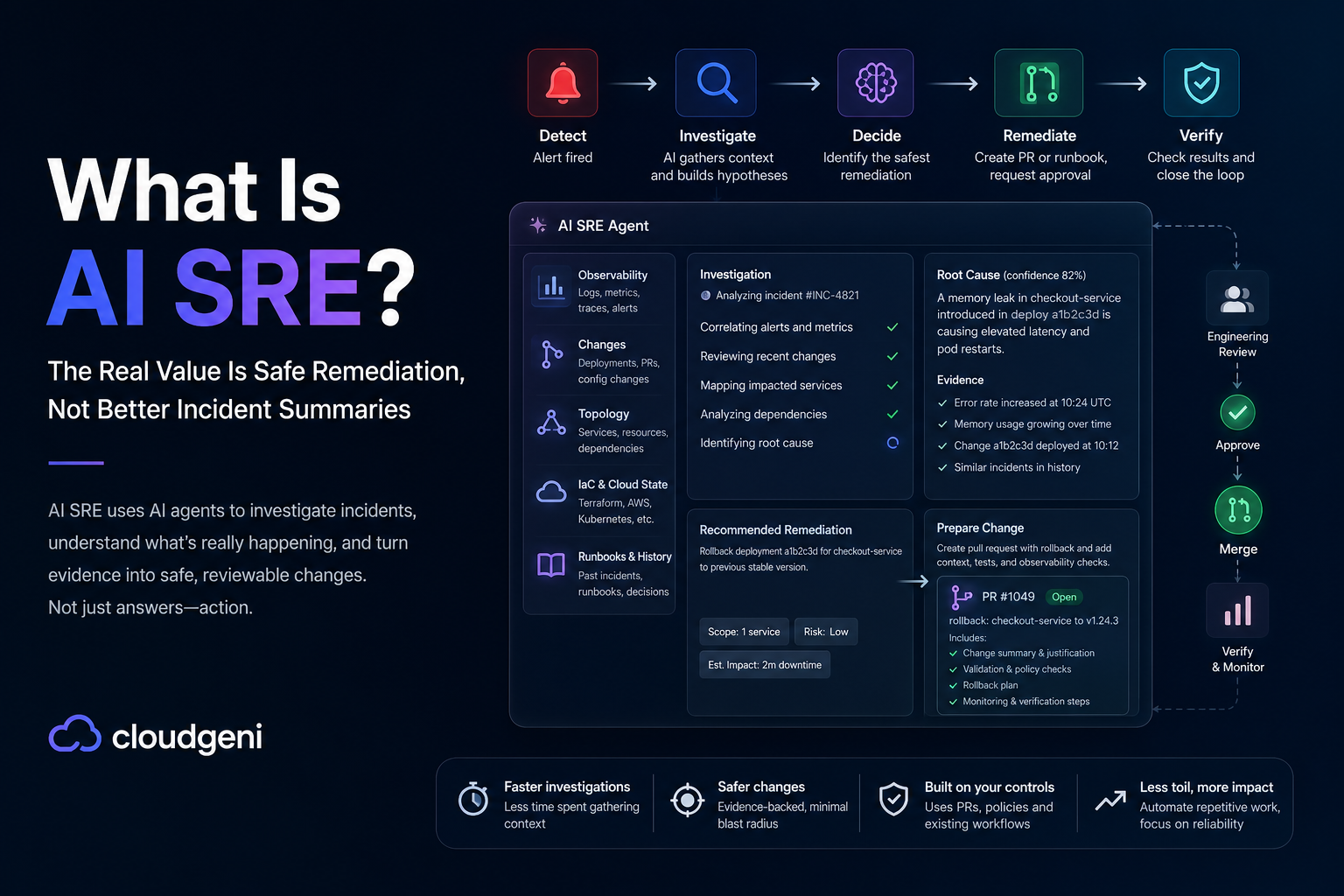
If you ask ten infrastructure vendors what AI SRE means, you will probably get twelve different answers.
For some, it means summarising alerts. For others, it means asking questions about Datadog in a chat window. Some describe anomaly detection with an LLM added on top. The more ambitious vendors promise autonomous agents operating production infrastructure while engineers sleep.
Most of these definitions either stop too early or go too far.
AI is already quite good at collecting information, summarising logs and producing a plausible explanation of what may have happened. That can save time during an incident.
But it is not the hardest part of reliability engineering.
The harder question is what happens next.
Can the system verify its hypothesis against real infrastructure context? Can it identify the smallest safe remediation? Can it prepare a change through the controls engineers already trust? Can it prove that the change worked?
That is where AI SRE becomes useful.
What is AI SRE?
AI SRE is the use of AI agents to support or automate site reliability engineering work, including incident investigation, root-cause analysis, remediation, infrastructure changes and reliability improvement.
Typical AI SRE tasks include:
- Correlating alerts, logs, metrics and traces
- Investigating affected services and dependencies
- Reviewing recent deployments and configuration changes
- Producing root-cause hypotheses
- Recommending or preparing remediations
- Executing approved runbooks
- Correcting infrastructure drift
- Generating incident timelines and postmortems
- Identifying reliability and cloud-cost improvements
The important word is not AI. It is SRE.
Site reliability engineering is an engineering discipline built around reliability targets, automation, risk management and the reduction of operational toil.
A useful AI SRE should reduce repetitive operational work and help turn incidents into lasting system improvements. It should not merely produce a cleaner summary of work an engineer still has to perform manually.
AI SRE vs AIOps, observability and incident management
AI SRE overlaps with several existing categories, but they are not the same.
| Category | Main purpose | Typical output |
|---|---|---|
| Observability | Makes system behaviour understandable | Logs, metrics, traces, dashboards and alerts |
| AIOps | Detects anomalies and correlates events | Grouped alerts, anomaly scores and predictions |
| Incident management | Coordinates people and processes | Escalations, timelines, communication and postmortems |
| AI SRE | Investigates problems and determines or performs the next action | Evidence-backed hypotheses, runbook actions and infrastructure changes |
Observability provides the evidence. AIOps reduces noise. Incident-management platforms coordinate the response.
AI SRE should use information from all three to answer a more operational question:
What should we do next, and how can we do it safely?
That distinction matters because most engineering organisations do not have a shortage of alerts. They have a shortage of time to investigate them, identify the correct action and implement the change that prevents the same issue from returning.
The market is overfocused on incident summaries
The typical AI SRE demo looks like this:
An alert fires. The agent gathers some logs, identifies a recent deployment and produces a polished incident summary. It suggests that the deployment caused the issue and recommends rolling it back.
That is useful. It is also the easy part.
The real operational work begins when the engineer asks:
- Is the deployment actually the cause, or did it merely happen at the same time?
- Is rollback safe after the database migration that ran with it?
- Which services depend on the affected component?
- Which repository and infrastructure module own the resource?
- Will the proposed change violate a security or availability policy?
- Who needs to approve it?
- How will we verify recovery?
- What happens if the AI is wrong?
A confident summary does not answer these questions.
This is the recurring problem with AI in infrastructure: a model can generate a reasonable explanation while missing one relationship, permission or historical decision that completely changes the correct action.
The goal should not be to produce the most convincing answer.
The goal should be to produce the smallest change that can be supported by evidence, reviewed and verified.
How should AI SRE work?
A production-grade AI SRE workflow needs five parts.
1. Understand current production reality
The agent needs more than logs.
It should understand cloud resources, Kubernetes workloads, services, network relationships, identities, repositories, deployments, infrastructure code and ownership information.
That context must be current.
An agent reasoning from an old architecture diagram or incomplete Terraform repository can reach a perfectly logical conclusion about an environment that no longer exists.
This is why infrastructure topology and cloud graph intelligence matter. The agent needs a machine-readable model of what exists, how resources relate to one another and what changed over time.
Without that grounding, dependency analysis becomes educated guessing.
2. Build a hypothesis from evidence
An AI SRE should not present one explanation as fact merely because it has the highest model probability.
It should show:
- Which signals support the hypothesis
- Which evidence contradicts it
- What changed before the incident
- Which services and users are affected
- Which alternative causes were considered
- What check would confirm or reject the conclusion
In production, explainability is not a cosmetic feature. It is part of the control system.
A system that cannot show why it reached a conclusion should not be trusted to act on it.
3. Propose the smallest safe action
Once the likely cause is understood, the agent should identify the most limited action that can restore reliability.
That could mean:
- Restarting one unhealthy workload
- Reverting a configuration value
- Scaling a constrained service
- Disabling a failed feature flag
- Preparing a Terraform change
- Rolling back a specific deployment
- Correcting an infrastructure policy violation
The agent should not widen the scope because a broader action is easier to generate.
A cluster-wide restart may remove the immediate symptom, but it may also increase disruption and hide the real failure.
The correct optimisation target is not “fix the incident at any cost.” It is “restore the service with the smallest defensible blast radius.”
4. Use existing engineering controls
An AI agent should not become a separate route around normal engineering governance.
For infrastructure managed through code, the natural execution boundary is usually a pull request.
The agent can prepare the change, attach the supporting evidence, run validation and policy checks, explain the expected impact and request approval.
A pull request provides what a chat window does not:
- A visible diff
- Review history
- CI checks
- Ownership
- Rollback
- A durable record of the change
Not every incident can wait for a pull request. Some operational actions need to happen through runbooks or direct APIs.
We have written more about why AI-generated infrastructure changes should move through existing engineering controls, rather than giving agents a separate route into production.
5. Verify the outcome
An AI SRE workflow is not complete when the command succeeds.
The system must verify that:
- The service recovered
- Relevant error rates or latency improved
- No unexpected dependency was affected
- The original failure condition disappeared
- The remediation did not introduce a new problem
The investigation, decision, approval, action and outcome should then become part of the operational history available during future incidents.
Otherwise, the organisation has automated the action without automating the learning.
What data does an AI SRE need?
The quality of an AI SRE is limited by the context it can access.
The most useful inputs normally include:
Observability data
Logs, metrics, traces, alerts, latency, error rates and user-facing service indicators show what the system is doing.
Change history
Recent releases, feature flags, infrastructure plans, configuration changes and manual cloud-console actions help answer the first question in most investigations: what changed?
Infrastructure topology
The agent needs to understand which services, resources, identities and network paths depend on one another.
A list of resources is not enough. The relationships between them often reveal both the cause and the blast radius.
Infrastructure as Code
Terraform, Pulumi, CloudFormation, Bicep or other infrastructure code shows intended state and provides a controlled mechanism for implementing durable remediations.
Live cloud state
Code shows intention. The live environment shows reality.
This gap is particularly visible in companies where years of manually created infrastructure still sit outside Terraform. We cover the practical problem in our guide to importing existing cloud resources into Infrastructure as Code.
Historical incidents and runbooks
Previous failures, attempted fixes and documented procedures can help the agent recognise known patterns and avoid repeating unsuccessful actions.
Ownership and business context
The technically obvious remediation is not always the right business decision.
The agent may need to understand service ownership, environment criticality, maintenance windows, customer impact and the cost of downtime.
No amount of model reasoning compensates for missing context. A more powerful model may simply produce a more persuasive wrong answer.
Common AI SRE use cases
Incident triage and root-cause analysis
An AI SRE can gather affected services, relevant telemetry, recent changes and similar incidents before an engineer starts investigating.
This is one of the safest first use cases because it is largely read-only and can reduce context switching without giving the agent control over production.
Infrastructure-drift remediation
Configuration drift occurs when the live cloud environment differs from the state declared in infrastructure code.
An AI SRE can detect the difference, evaluate its impact and propose whether the code should be updated to match reality or the environment should be returned to the declared state.
The useful output is not another drift alert. It is a reviewable drift-remediation pull request that restores alignment between live infrastructure and code.
Security and policy remediation
Cloud-security platforms already produce large numbers of findings.
The backlog grows because each finding still needs to be investigated, assigned and converted into a safe technical change.
An AI SRE can collect the relevant context, determine whether the finding is real, prepare the smallest remediation and send it through policy checks and review.
Kubernetes troubleshooting
Kubernetes incidents often require engineers to move between pod events, deployments, ReplicaSets, resource limits, networking, secrets and application logs.
An agent can correlate these systems and reduce manual investigation.
Kubernetes is also a good example of why constrained permissions matter. A service account with broad cluster access can turn an incorrect diagnosis into a significantly larger incident.
Runbook execution
Well-defined and repeatedly tested runbooks are strong candidates for bounded agent execution.
The agent can select the correct runbook, populate the inputs, request approval when required and verify the result.
Predictable workflows should still use deterministic automation where possible. An LLM is not an improvement simply because it is newer.
FinOps remediation
FinOps has a similar problem to incident management.
Companies already have tools identifying idle resources, oversized workloads and unusual spending. What is missing is the engineering work required to validate and implement the recommendation.
An AI SRE can investigate utilisation, ownership, dependencies and infrastructure code, then prepare a safe rightsizing or cleanup change.
That moves FinOps from reporting possible savings toward delivering safe, actionable cloud-cost remediations.
Why fully autonomous AI SRE is mostly a bad idea
“Autonomous SRE” is an attractive phrase because it suggests that companies can remove operational work entirely.
The uncomfortable truth is that broad infrastructure permissions combined with a probabilistic model are not autonomy.
They are an unpriced blast radius.
Production environments contain incomplete telemetry, undocumented exceptions, legacy dependencies and business context that may not be available to the agent.
Even a highly capable model will sometimes be wrong.
The reasonable response is not to avoid AI. It is to design the system around the assumption that the AI will eventually make a mistake.
That means:
- Giving every agent a defined identity and role
- Restricting tools and permissions
- Requiring evidence for important decisions
- Enforcing critical policies outside the prompt through deterministic validation and guardrails
- Recording every action
- Maintaining rollback and fallback paths
- Requiring approval for high-risk changes
Human approval is not evidence that the agent has failed to become autonomous.
For significant production changes, approval is the product working correctly.
A sensible adoption path
There is no serious reason to move directly from a chat assistant to an agent with administrator access to production.
A safer adoption path has three stages.
Stage 1: Read-only investigation
Connect telemetry, deployment history, incident records and infrastructure topology.
Let the agent summarise incidents and produce evidence-backed hypotheses without performing changes.
Measure where it is accurate, where context is missing and how often engineers find the output useful.
Stage 2: Remediation preparation
Allow the agent to prepare tickets, runbook inputs, pull requests and remediation plans.
The agent handles repetitive investigation and drafting. An engineer remains responsible for review and execution.
This is often where the economics become attractive. The organisation removes meaningful toil without taking on the full risk of autonomous production changes.
Stage 3: Bounded execution
Automate narrow, well-understood and reversible workflows after the system has demonstrated sufficient precision.
Each workflow should have explicit permissions, validation, rollback and escalation.
Autonomy should be granted per action. It should not be treated as a general capability assigned to the agent.
How to evaluate an AI SRE tool
Before giving an AI system access to infrastructure, ask:
- What evidence supports each conclusion?
- Can the agent see live state as well as infrastructure code?
- How are agent identities and permissions managed?
- Are critical policies enforced outside the model?
- Can changes be proposed through pull requests or approved runbooks?
- Which actions require human approval?
- Is every tool call and action auditable?
- How does the system verify that a remediation worked?
- What happens when the model or integration fails?
- How are false recommendations and failed actions measured?
A polished incident summary is not enough.
Ask to see the execution model.
The Cloudgeni view of AI SRE
At Cloudgeni, we are not particularly interested in putting another chat interface on top of cloud dashboards.
Infrastructure teams already have an enormous amount of information: alerts, security findings, drift findings, cost recommendations and policy violations.
The missing layer is often the work required to turn that information into a safe technical change.
Our view is that infrastructure agents should connect live cloud state with Infrastructure as Code and engineering context, then prepare bounded, reviewable remediations through the controls teams already trust.
The agent investigates and proposes.
Deterministic systems validate.
Policies restrict.
Engineers approve where the risk requires it.
That may sound less impressive than promising a fully autonomous SRE operating production while everyone sleeps.
It is also much closer to something a serious engineering organisation can deploy.
Frequently asked questions
What is AI SRE in simple terms?
AI SRE is the use of AI agents to help engineers investigate production problems, identify likely causes and prepare or perform approved remediations.
Will AI replace SREs?
No. AI will automate parts of incident investigation, evidence gathering, remediation preparation and operational documentation. Engineers will still define reliability objectives, assess risk and approve significant changes.
What is the difference between AI SRE and AIOps?
AIOps mainly detects anomalies, correlates events and reduces alert noise. AI SRE uses operational information to investigate reliability issues and determine or perform the next action.
Is AI SRE the same as observability?
No. Observability provides the telemetry needed to understand a system. AI SRE uses that telemetry, together with deployment and infrastructure context, to investigate and act.
Can AI SRE fix incidents automatically?
Yes, but only selected workflows should be fully automated. High-risk actions should use constrained permissions, policy checks, approval requirements, verification and rollback.
Is AI SRE safe for production?
Not by default. It becomes safer when the agent is grounded in current state, operates with least-privilege access and sends changes through controlled and auditable workflows.
What is the best first AI SRE use case?
Start with read-only incident investigation or remediation preparation. Both can remove substantial manual work while keeping production changes under human control.
Closing
AI SRE will become a meaningful part of how cloud systems are operated, but not because language models are suddenly better infrastructure engineers than the people currently on call.
The opportunity is more practical.
Agents can gather context, connect signals across systems, investigate repetitive problems and prepare changes that engineers previously did not have time to implement.
They can compress the operational work surrounding an engineering decision without pretending that judgment and risk have disappeared.
The winners in this market will not be the systems that sound most confident during a demo.
They will be the systems that can be wrong without breaking production.