
10 Best AI Tools for DevOps and Platform Engineering in 2026

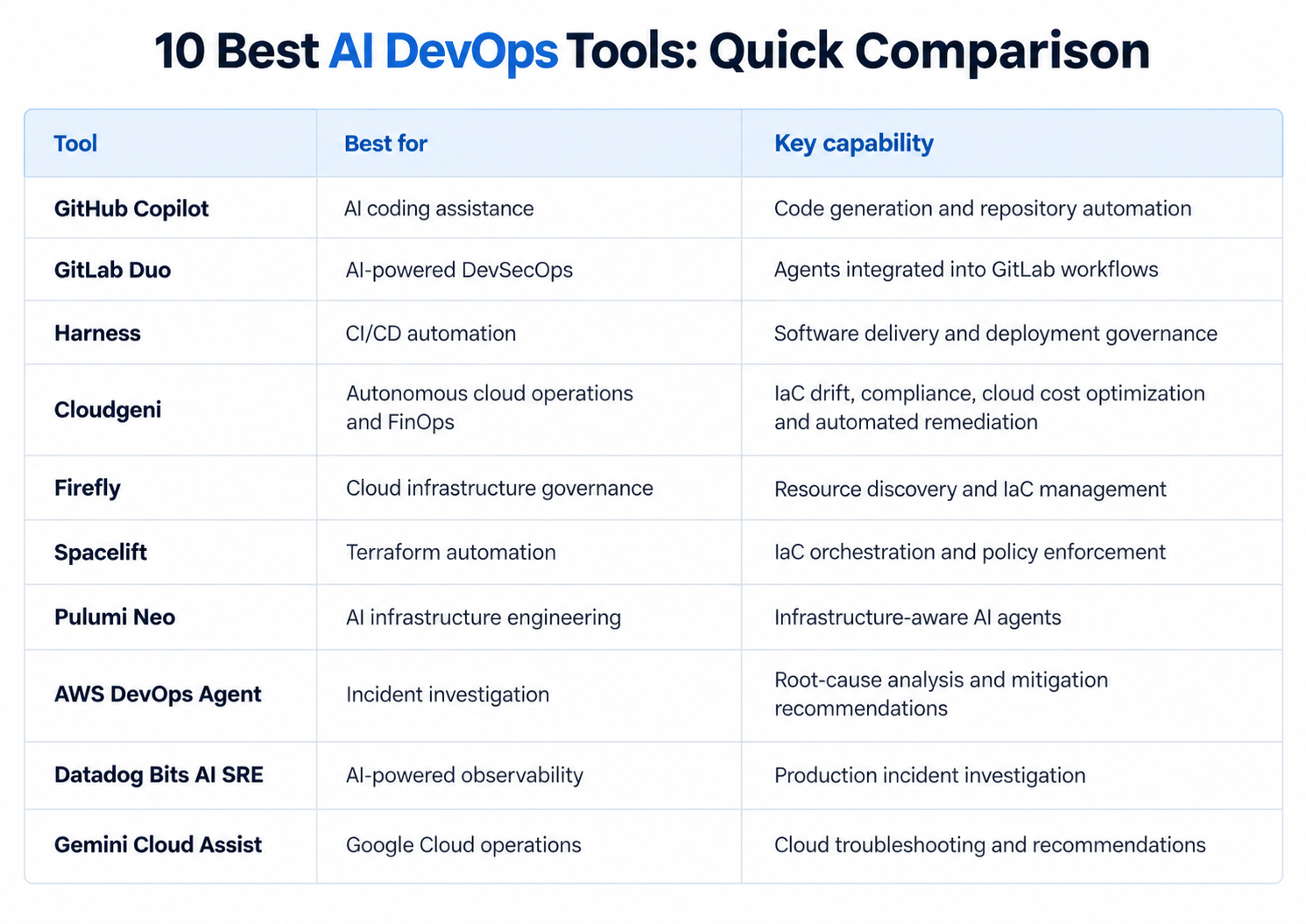
AI is changing DevOps, but not all AI DevOps tools solve the same problem. Some help engineers write code. Others investigate incidents, automate deployments, or manage cloud infrastructure.
The difference matters.
Generating Terraform code is relatively easy. Knowing whether that code reflects the actual state of production, complies with security policies, and can be safely deployed is considerably harder.
We've spent the last two years building AI for cloud infrastructure and working with platform engineering teams. One thing keeps coming up: organizations have plenty of tools telling them what needs fixing. What they lack is the engineering capacity to fix everything.
Here are 10 AI tools worth evaluating in 2026, from coding assistants to autonomous infrastructure agents.
10 Best AI DevOps Tools: Quick Comparison
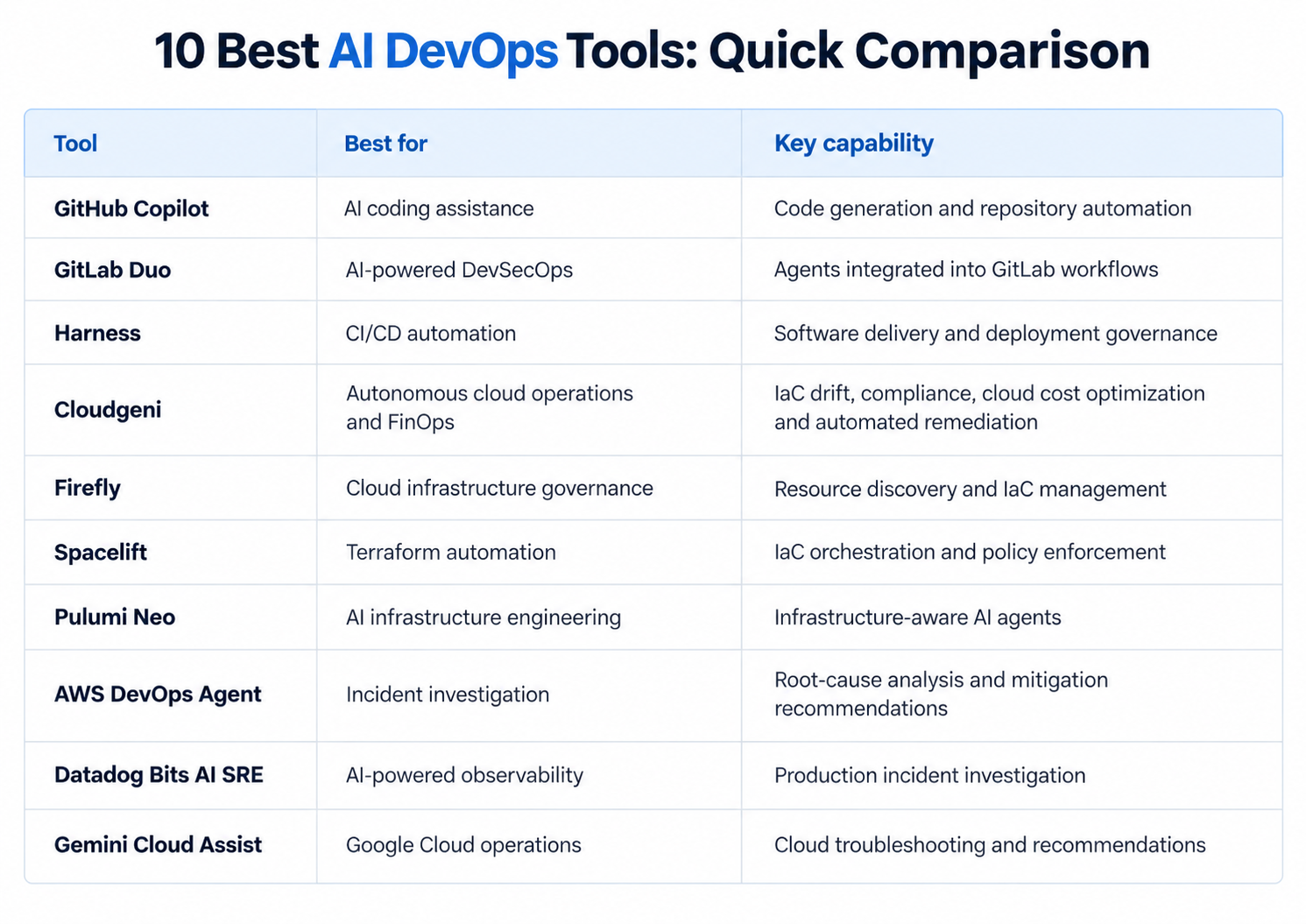
These tools overlap in some areas, but they are not interchangeable. The best choice depends on which part of the DevOps lifecycle you want to automate.
1. GitHub Copilot — Best for AI-Assisted Development in Microsoft Ecosystem
Website: https://github.com/features/copilot
GitHub Copilot has moved well beyond autocomplete. Its coding agent can investigate issues, modify repository files, create branches and prepare pull requests.
For DevOps teams, it's useful for writing Terraform configurations, Kubernetes manifests, CI/CD pipelines and automation scripts.
The biggest advantage is that it works inside an environment developers already use.
Best for:
- Writing and refactoring infrastructure code
- Maintaining GitHub Actions workflows
- Automating repository-level engineering tasks
Limitation: Copilot primarily operates with code and the context available through its tools. It does not inherently know whether Terraform matches the live cloud environment or whether a proposed infrastructure change is operationally safe.
Verdict: An excellent development assistant, but not a complete infrastructure operations platform.
2. GitLab Duo — Best for AI-Powered DevSecOps
Website: https://about.gitlab.com/gitlab-duo/
GitLab Duo brings AI into software development workflows, including code changes, merge requests and pipeline-related tasks.
Its Agent Platform supports specialized agents that work with GitLab project context.
For enterprises using GitLab as their central development platform, this reduces the need to introduce additional tools for routine engineering automation.
Best for:
- AI-assisted code development
- Merge-request workflows
- CI/CD-related engineering tasks
Limitation: Understanding a repository or delivery pipeline is not the same as understanding live production infrastructure. Organizations still need external operational context for certain infrastructure remediation workflows.
Verdict: A logical choice for teams already standardized on GitLab.
3. Harness — Best for AI-Powered Continuous Delivery
Website: https://www.harness.io/
Writing code faster achieves little if deploying it remains slow, risky or complicated.
Harness tackles this problem through software delivery automation, infrastructure management, deployment governance and developer workflows.
Its platform brings AI capabilities into processes that typically require considerable manual coordination.
For larger engineering organizations, the value is in standardizing how software moves from development into production.
Best for:
- Continuous integration and delivery
- Deployment automation and governance
- Standardizing engineering workflows across teams
Limitation: Harness is primarily a broader software delivery platform. Teams seeking autonomous remediation of unmanaged cloud resources or IaC drift should evaluate those capabilities separately.
Verdict: Particularly relevant for enterprises with complex delivery processes and multiple engineering teams.
4. Cloudgeni — Best for Autonomous Cloud Operations and FinOps
Website: https://cloudgeni.ai/
Disclosure: Cloudgeni is our product.
Cloud infrastructure teams have no shortage of tools telling them what needs attention.
A drift detector flags configuration changes. A security scanner identifies misconfigurations. A FinOps platform recommends shutting down idle resources or rightsizing instances.
The problem is what happens next.
Someone still has to investigate the finding, understand the infrastructure dependencies, prepare a change, validate it and get it deployed.
Cloudgeni focuses on automating that work.
Its AI agents connect live cloud infrastructure with Infrastructure as Code to help teams identify and remediate infrastructure drift, compliance issues and cloud cost inefficiencies.
Best for:
- Detecting and remediating infrastructure drift
- Importing unmanaged resources into Infrastructure as Code
- Generating Terraform remediation pull requests
- Addressing compliance and security misconfigurations
- Identifying cloud cost optimization opportunities
- Automating FinOps actions such as rightsizing and idle-resource cleanup through controlled workflows
Example: A company has several oversized cloud instances and unused resources generating unnecessary costs.
A traditional FinOps tool identifies potential savings and presents them in a dashboard. Engineers then need to review dependencies, update infrastructure configurations and implement the changes.
Cloudgeni's FinOps approach is designed to connect cost optimization recommendations with engineering workflows, allowing agents to investigate opportunities and prepare changes for approval.
The same principle applies to infrastructure drift and compliance findings.
The difference is moving from recommendations to action.
Limitation: Cloudgeni isn't intended to replace enterprise financial reporting systems, general-purpose coding assistants or comprehensive observability platforms. Its focus is the operational implementation of cloud infrastructure improvements.
Verdict: Best suited to platform engineering, DevOps and FinOps teams looking to automate infrastructure management, compliance remediation and cloud cost optimization within governed workflows.
5. Firefly — Best for Cloud Infrastructure Discovery and Governance
Website: https://www.firefly.ai/
One of the more persistent cloud engineering problems is that organizations don't actually know everything running in their environments.
Infrastructure may be provisioned through Terraform, cloud consoles, scripts or third-party integrations.
Firefly helps organizations discover cloud resources, improve Infrastructure-as-Code coverage and identify governance issues.
Its AI capabilities support infrastructure management and remediation workflows.
Best for:
- Discovering unmanaged cloud resources
- Improving Infrastructure-as-Code coverage
- Identifying infrastructure governance gaps
Limitation: Buyers should distinguish between identifying infrastructure problems and completing their remediation. Evaluate exactly which changes the platform can prepare, validate and execute within your environment.
Verdict: A strong option for organizations prioritizing infrastructure visibility and governance.
6. Spacelift — Best for Terraform and IaC Orchestration
Website: https://spacelift.io/
As Terraform adoption grows, managing infrastructure changes becomes a significant engineering challenge.
Spacelift provides infrastructure orchestration, including policy enforcement, drift detection, workflow management and controlled execution.
Its AI capabilities also help engineers diagnose issues in infrastructure workflows.
For teams managing hundreds of Terraform stacks, reliable orchestration can be more valuable than additional code generation.
Best for:
- Terraform workflow orchestration
- Policy enforcement and approvals
- Infrastructure drift detection
- Managing complex IaC environments
Limitation: Orchestrating infrastructure changes and autonomously identifying what needs remediation are different problems.
Spacelift is particularly strong in governing and executing infrastructure workflows.
Verdict: A strong fit for mature Terraform teams needing centralized control over infrastructure delivery.
7. Pulumi Neo — Best for AI-Assisted Infrastructure Engineering
Website: https://www.pulumi.com/
Pulumi has been pushing Infrastructure as Code beyond traditional configuration languages, and Pulumi Neo extends that direction into agentic infrastructure engineering.
Rather than simply generating cloud configuration, the ambition is to give AI agents enough infrastructure context to plan and prepare meaningful changes.
This addresses one of the biggest weaknesses of generic coding agents: infrastructure decisions depend on existing resources, dependencies and deployment constraints.
Best for:
- AI-assisted infrastructure changes
- Infrastructure-aware agent workflows
- Teams using or evaluating Pulumi
Limitation: Organizations with extensive Terraform environments should evaluate workflow compatibility and the implications of introducing another infrastructure platform.
Verdict: Worth evaluating for teams looking to make AI a more integrated part of infrastructure engineering.
8. AWS DevOps Agent — Best for Production Incident Investigation
Website: https://aws.amazon.com/devops-agent/
AWS DevOps Agent represents an important shift from AI coding assistance toward AI-powered operations.
It can investigate production incidents by examining telemetry, infrastructure relationships, code and deployment context.
The agent helps identify likely root causes and recommends mitigation or prevention measures.
For teams handling complex production incidents, this can reduce the time engineers spend manually correlating information across systems.
Best for:
- Root-cause analysis
- Production incident investigation
- Identifying recurring reliability issues
Limitation: Root-cause analysis doesn't automatically mean the underlying infrastructure gets permanently fixed. Buyers should evaluate the distinction between investigation, recommended mitigation and actual remediation.
Verdict: A significant development for SRE teams looking to automate incident investigation.
9. Datadog Bits AI SRE — Best for AI-Powered Observability
Website: https://www.datadoghq.com/
Datadog already has something many AI agents struggle to acquire: extensive production telemetry.
Its Bits AI SRE capabilities use that information to investigate incidents and correlate signals from logs, metrics and traces.
This helps reduce the manual work involved in understanding why applications and infrastructure are behaving unexpectedly.
Best for:
- Investigating production incidents
- Correlating operational telemetry
- Accelerating root-cause analysis
Limitation: Identifying an incident's cause isn't necessarily the same as implementing a durable fix. Infrastructure changes may still require separate engineering workflows.
Verdict: Particularly attractive for organizations already using Datadog extensively.
10. Gemini Cloud Assist — Best for Google Cloud Operations
Website: https://cloud.google.com/products/gemini/cloud-assist
Gemini Cloud Assist integrates AI assistance into Google Cloud operations.
It helps engineers investigate problems, interpret operational information and identify potential remediation steps.
Its investigation capabilities can analyze supported Google Cloud resources and provide actionable recommendations.
For teams heavily invested in Google Cloud, this provides a more contextual alternative to generic AI assistants.
Best for:
- Google Cloud troubleshooting
- Understanding infrastructure configurations
- Investigating operational problems
Limitation: Its deepest integration is within Google Cloud, and some investigation capabilities have eligibility or access requirements.
Verdict: Worth evaluating for Google Cloud teams seeking AI-assisted operations within their existing environment.
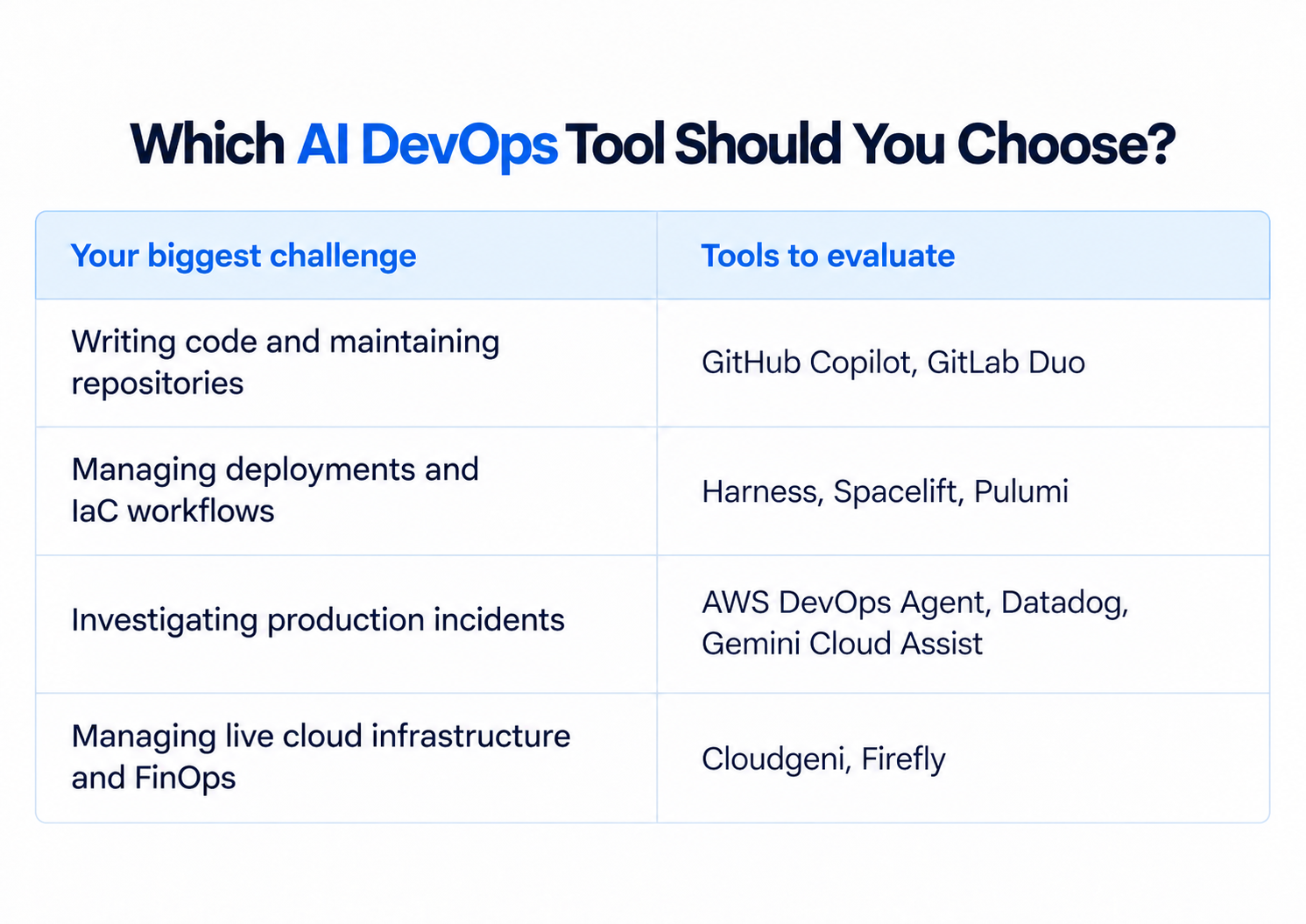
Which AI DevOps Tool Should You Choose?
The tools in this list fall into four broad categories.
One mistake we see organizations make is assuming that adopting an AI coding assistant means they've automated DevOps.
They haven't.
A coding assistant makes engineers faster at producing changes. That doesn't mean infrastructure problems get discovered, investigated or resolved without significant manual involvement.
Likewise, an AI incident investigator might explain exactly why production failed but still leave an engineer responsible for implementing the fix.
The real test of an AI DevOps tool is simple: How much of the operational workflow does it actually complete?
Does it identify the problem? Does it understand the relevant infrastructure? Can it prepare a fix? Can it validate that fix? And can it fit into existing approval and deployment processes?
These questions matter more than whether the product has a chatbot, uses multiple agents or claims to be autonomous.
Final Thoughts: DevOps Is Moving Beyond AI Coding Assistants
The first wave of AI made developers faster at writing code.
The next wave is addressing the operational work surrounding it.
And that work extends well beyond deployments.
Cloud infrastructure needs continuous optimization. Resources drift from their intended configurations. Compliance findings accumulate. Companies spend millions on cloud services while cost optimization recommendations remain unimplemented.
We already have plenty of tools that identify these problems.
What we need are systems that can act on them.
An AI agent should be able to identify an oversized instance, assess its dependencies, prepare the infrastructure change and submit it for review. The same applies to security misconfigurations, unmanaged cloud resources and infrastructure drift.
This is where we believe autonomous cloud operations are heading: a single operational approach to reliability, compliance, infrastructure management and FinOps.
The next generation of DevOps tools won't be judged by how many recommendations they produce.
They'll be judged by how many problems they help resolve.
Explore Cloudgeni — autonomous cloud infrastructure operations and FinOps, or read our comparison of the 10 Best AI Agents for Cloud Infrastructure Management in 2026.