The Future of Internal Developer Platforms: From Ticket Queues to AI-Powered Self-Service

How AI is Transforming the Way Developers Interact with Infrastructure
The promise of DevOps was simple: break down silos between development and operations, ship faster, and empower everyone to take ownership of the software delivery lifecycle. But somewhere along the way, that promise got complicated. Instead of liberation, many development teams found themselves drowning in a sea of tools, configurations, and ticket queues. Internal Developer Platforms (IDPs) emerged as the solution—but the first generation of these platforms came with their own set of challenges.
Today, we stand at an inflection point. AI-driven platforms like Cloudgeni are redefining what an IDP can be: not just a self-service portal, but an intelligent partner that understands intent, enforces guardrails, and generates compliant infrastructure code—all while giving developers the flexibility they need.
The Old World: When IDPs Became Another Bottleneck
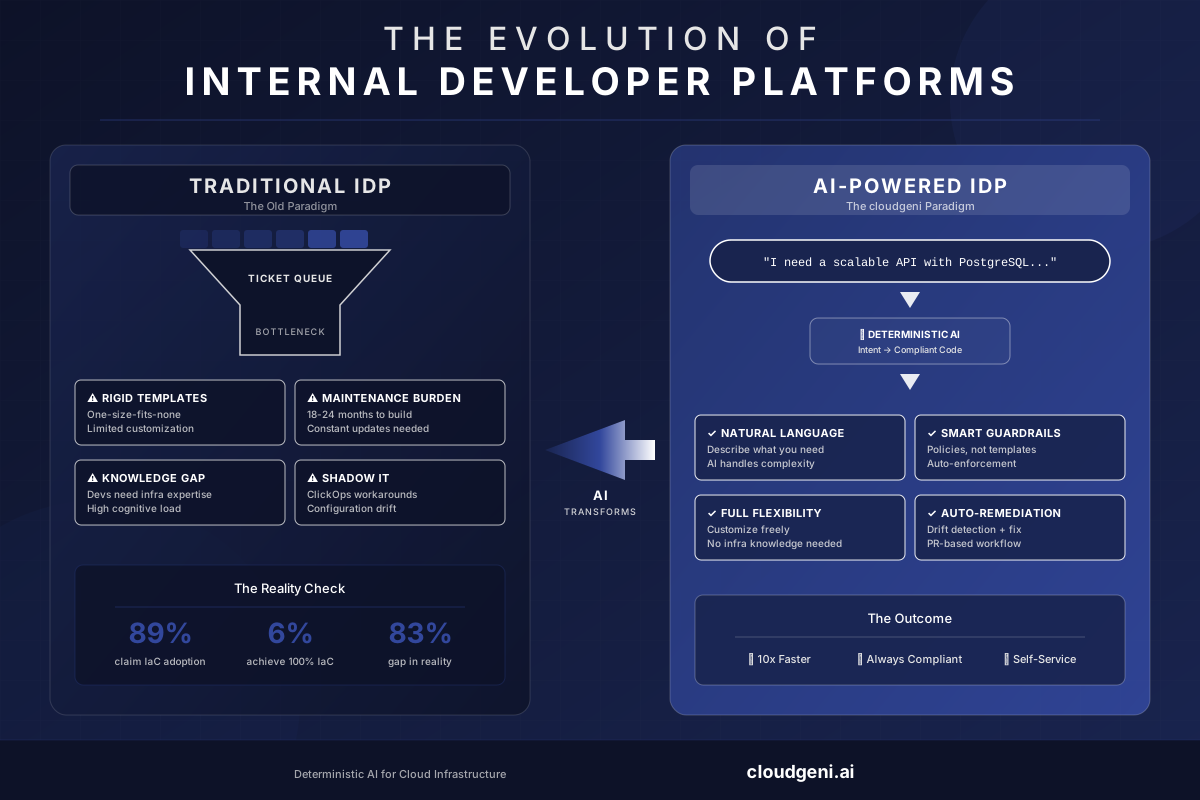
Traditional Internal Developer Platforms were built with good intentions. Platform engineering teams would spend months—sometimes 18 to 24 months—building elaborate self-service systems. The goal was noble: abstract away the complexity of cloud infrastructure and let developers focus on writing code.
But the reality often fell short of the vision.
The Infrastructure Team Burden
Building a traditional IDP requires platform engineers to anticipate every possible use case developers might have. They must create templates, workflows, and abstractions for provisioning environments, configuring CI/CD pipelines, managing secrets, and orchestrating deployments. Each new capability requires custom development, testing, and maintenance.
The result? Platform teams become perpetual bottlenecks. According to industry research, platform engineering teams are almost universally understaffed while facing the need to support development teams twice their size. Every new requirement becomes a ticket, every customization becomes a project, and the backlog grows faster than it shrinks.
The One-Size-Fits-None Problem
Traditional IDPs force standardization by design. While standardization has its benefits—consistency, governance, reduced cognitive load—it comes at a cost. Development teams with unique requirements find themselves shoehorned into pre-defined templates that don't quite fit their needs.
A frontend team might need different infrastructure patterns than a machine learning team. A startup within an enterprise might need to move faster than the established golden paths allow. When the platform can't accommodate these differences, developers do what developers do: they work around the system. They click through cloud consoles (the dreaded "ClickOps"), create shadow IT, and introduce the very drift and inconsistency the platform was designed to prevent.
The Knowledge Gap
Even with self-service portals, traditional IDPs still assume developers have a baseline understanding of infrastructure concepts. Terms like "IAM policies," "VPC configurations," and "Terraform state" appear in interfaces designed for "simplicity." Developers who just want to deploy an application find themselves needing to understand networking, security groups, and cloud-specific terminology. The cognitive load doesn't disappear—it just shifts from infrastructure management to infrastructure understanding.
The Future: AI-Powered Platforms That Actually Serve Developers
The next generation of Internal Developer Platforms doesn't just automate infrastructure—it understands it. Platforms like Cloudgeni represent a fundamental shift in how we think about developer self-service: from rigid templates to intelligent, adaptive systems that bridge the gap between what developers need and what infrastructure teams require.
Golden Paths Defined by Platform Engineers
In the AI-powered IDP model, platform engineers shift from building portals to defining policies. Instead of creating rigid templates, they describe the "golden paths"—the approved patterns, security requirements, and compliance standards that must be met. These might include rules like: "All storage must be encrypted at rest," "No public IP addresses on databases," or "IAM policies must follow least-privilege principles."
Cloudgeni takes these high-level requirements—which can even be described in natural language—and translates them into hard policies that run behind the scenes. Platform engineers maintain control over what's allowed without having to build every possible implementation themselves.
Natural Language Requirements, Hard Policy Enforcement
Imagine a platform engineer writing: "Developers can provision databases in any region, but all databases must have automated backups enabled, encryption at rest, and network access restricted to our VPC." In traditional IDPs, this would require building a custom portal, writing validation logic, and creating documentation.
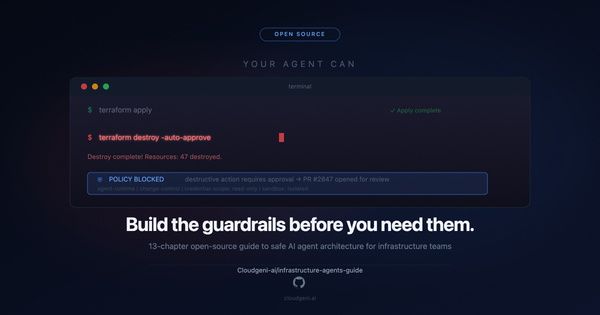
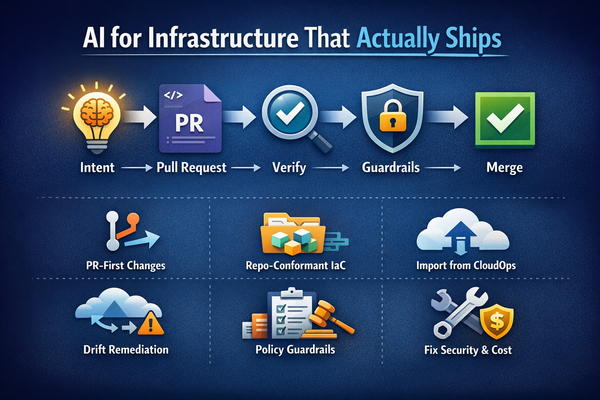
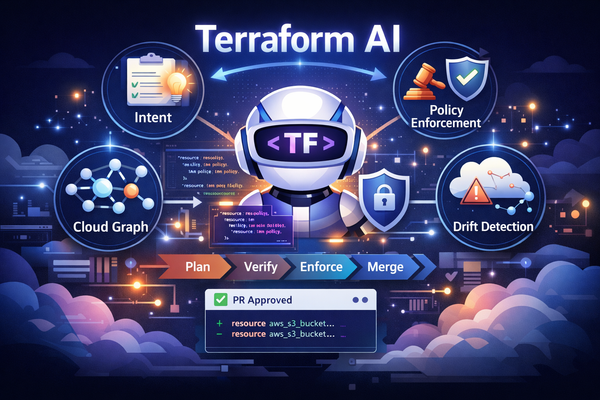
With AI-powered platforms, these natural language requirements become the specification. The AI understands the intent, generates the appropriate Terraform configurations, and automatically validates that generated code meets all stated requirements. Every pull request gets scanned; misconfigurations get blocked; compliant patches get generated automatically. The guardrails become invisible to developers but remain absolute in enforcement.
Full Flexibility for Developers
Here's where the paradigm truly shifts. Traditional IDPs offered limited flexibility within rigid templates. AI-powered platforms flip this model: they offer full flexibility within clear boundaries.
Developers can describe what they need in their own words: "I need a scalable API backend with a PostgreSQL database and Redis caching." The AI generates infrastructure code that matches your organization's modules, naming conventions, tagging standards, and environment patterns. Developers can then modify, customize, and iterate on this foundation without needing to understand Terraform syntax or cloud-specific configurations.
The key insight is that developers get to use the platform in whatever way suits their workflow—through chat interfaces, IDE extensions, or direct API calls—while the platform ensures that every generated artifact complies with organizational standards.
Minimal Input, Maximum Output
The best infrastructure is the infrastructure you don't have to think about. AI-powered IDPs embody this philosophy by requiring minimal input from developers. Instead of filling out forms with dozens of fields, developers express intent. Instead of navigating portal wizards, they describe outcomes. The AI handles the translation from "what I want" to "what needs to be configured," complete with security controls, compliance requirements, and organizational best practices baked in.
Cloudgeni: Deterministic AI for Infrastructure You Can Trust
Cloudgeni represents this new paradigm in action. At its core, Cloudgeni uses what they call "deterministic AI"—AI that doesn't just generate code, but generates code you can verify and trust.
The distinction matters. In frontend or application code, "close enough" might be acceptable. But in infrastructure, a misconfigured IAM policy, a drift-inducing Terraform fix, or a too-permissive security group can have catastrophic consequences. Cloudgeni's AI agents scan codebases, block misconfigurations, generate compliant Terraform patches, and maintain a full audit trail—enabling development teams to move quickly without sacrificing security or compliance.
Key Capabilities
|
Capability |
Traditional
IDP |
AI-Powered
IDP (Cloudgeni) |
|
Infrastructure
Provisioning |
Pre-built
templates with limited customization |
Natural
language requests generating customized, compliant code |
|
Guardrail
Enforcement |
Manual
reviews and post-deployment audits |
Automatic
validation and blocking at code generation time |
|
Configuration
Drift |
Detected but
manually remediated |
Auto-detected
with AI-generated PR fixes |
|
Developer
Experience |
Portal
navigation and form filling |
Conversational
interface with intent understanding |
|
Platform
Team Effort |
Build and
maintain templates for every use case |
Define
policies; AI handles implementation |
|
Compliance |
Periodic
audits and manual remediation |
Continuous
enforcement with full audit trail |
The Path Forward: What This Means for Your Organization
The transition from traditional IDPs to AI-powered platforms isn't just a technology upgrade—it's a fundamental rethinking of how platform engineering works. Here's what changes:
For Platform Engineers: Your role evolves from building portals to defining policies. You become architects of guardrails rather than implementers of templates. Your deep infrastructure knowledge becomes encoded in rules that scale across your entire organization.
For Developers: Infrastructure becomes something you describe, not something you configure. You get the speed of ClickOps with the governance of Infrastructure as Code. You can customize and iterate without waiting on tickets or learning new domains.
For Security and Compliance Teams: Policies become proactive rather than reactive. Instead of auditing after deployment, requirements are enforced at generation time. Compliance becomes continuous and automatic rather than periodic and painful.
For the Business: Faster time to market without increased risk. Reduced platform engineering overhead. Lower cloud costs through optimized configurations. And most importantly: developers who spend their time building features rather than fighting infrastructure.
Conclusion: The IDP That Gets Out of Your Way
The future of Internal Developer Platforms isn't more complexity hidden behind simpler interfaces. It's genuine simplicity—powered by AI that understands infrastructure deeply enough to make the right decisions automatically.
Cloudgeni and platforms like it represent a world where developers describe what they need and get compliant, production-ready infrastructure in return. Where platform engineers define guardrails once and have them enforced everywhere. Where security and speed aren't trade-offs but complementary outcomes.
The Internal Developer Platform of the future doesn't just serve developers—it empowers them. And it does so by finally delivering on the original promise of DevOps: letting developers focus on building great software while infrastructure takes care of itself.
— — —
Ready to explore the next generation of infrastructure management? Learn more at Cloudgeni.ai